

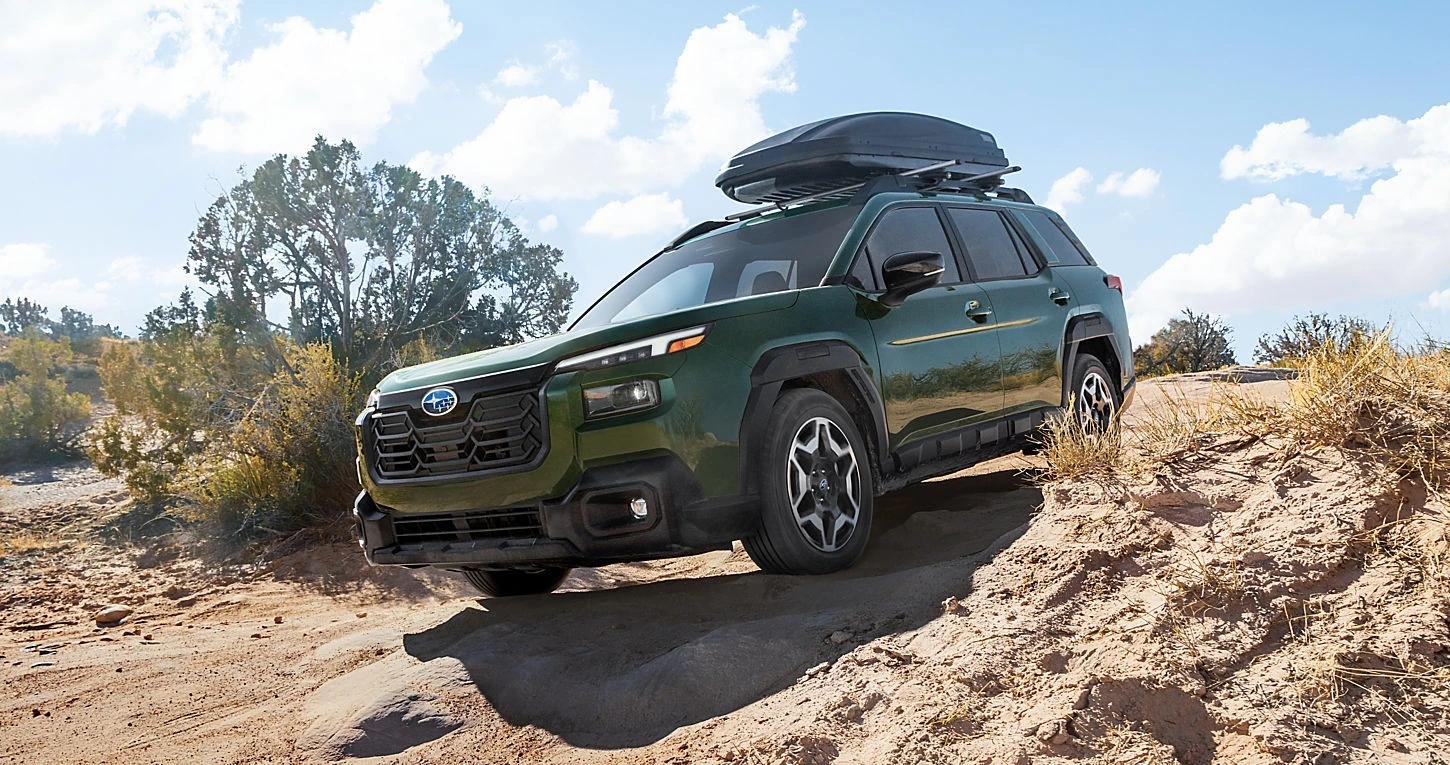
How to Charge Your Subaru EV: A Guide to the 2026 and 2027 Subaru Trailseeker, Solterra and Uncharted
So you're eyeing one of Subaru's electric SUVs (or you just brought one home, congrats!). The first question almost everyone asks us at Ruge's Subaru in Rhinebeck is some version of "okay, but how do I actually charge this thing?" Good news: it's a lot simpler than it sounds. Below we'll walk through what comes in the box, the three ways to charge, what you'll want set up at home, and how long each model takes to get to 80%.
Quick heads-up before we dive in: the 2026 and 2027 Trailseeker, Solterra and Uncharted all share the same core charging hardware. Every one of them uses a 74.7-kWh battery, an 11-kW onboard charger and a native NACS charge port that's rated for DC fast charging up to 150 kW. That makes charging times nearly identical across the lineup, which keeps this guide nice and tidy.
What Chargers and Adapters Come With Your Subaru EV?
Starting with the 2026 model year, Subaru switched its EVs to the North American Charging Standard (NACS) port, the same plug style Tesla uses. That opens up Tesla Superchargers with no adapter at all. For everything else, Subaru includes what you need:
- 2026 and 2027 Trailseeker: a Level 1/Level 2 portable charging cable, plus a J1772-to-NACS adapter (for most public Level 2 stations) and a CCS1-to-NACS adapter (for non-Tesla DC fast chargers). These are standard on every trim.
- 2026 and 2027 Solterra: a portable dual-voltage (L1/L2) charger kit with J1772 and CCS adapters, standard.
- 2026 and 2027 Uncharted: the same NACS port, 11-kW onboard charger and Level 1/Level 2 compatibility. Ask our team to confirm exactly which cable and adapters ship with the specific Uncharted you're looking at.
Pro tip: keep your adapters in the car, not the garage. The day you need the CCS adapter is usually the day you're two towns away from home.
The Three Ways to Charge
Level 1: A Regular 120V Household Outlet
Plug the included cable into a standard wall outlet and you're charging. It's slow (think a few miles of range per hour), but it's free to set up and works great for topping off overnight if you don't drive a ton, or as a backup when you're visiting family.
Level 2: A 240V Home Charger or Public Station
This is the sweet spot for most owners. A 240V Level 2 setup at home lets you plug in when you get home and wake up to a charged battery every morning. You'll also find Level 2 stations at shopping centers, hotels, workplaces and parking garages around the Hudson Valley.
Level 3: DC Fast Charging
This is your road-trip charger. Pull into a Tesla Supercharger (plug straight in thanks to that NACS port) or a CCS fast charger like Electrify America or EVgo (use the included CCS adapter), and you can go from 10% to 80% in about the time it takes to grab lunch.
How Long Does It Take to Charge to 80%?
Here's the part everyone wants. The DC fast charging numbers come straight from Subaru. The Level 1 and Level 2 numbers are our estimates for a 10% to 80% charge, based on the 74.7-kWh battery, the 11-kW onboard charger and typical charging losses. Real-world times shift with temperature, battery condition and the charger itself.
| Model (2026 and 2027) | Level 1 (120V) 10% to 80% |
Level 2 (240V, 48A) 10% to 80% |
Level 3 DC Fast 10% to 80% |
|---|---|---|---|
| Subaru Trailseeker | About 40 to 45 hours | About 4.5 to 5.5 hours | About 28 minutes |
| Subaru Solterra | About 40 to 45 hours | About 4.5 to 5.5 hours | About 28 minutes |
| Subaru Uncharted | About 40 to 45 hours | About 4.5 to 5.5 hours | About 28 minutes |
Level 2 on a smaller 32-amp charger will take closer to 7.5 to 8.5 hours for the same 10% to 80%, still easily done overnight. DC fast charging time is Subaru's estimate at up to 150 kW in ideal conditions.
Why does everyone talk about 80%? Charging slows down a lot above that point to protect the battery, so 10% to 80% is the fastest, most useful chunk of the battery and the standard way automakers compare charge times. For daily driving, setting your charge limit to 80% is a smart habit anyway.
What to Make Sure You Have Set Up at Home
For Level 1 Charging
- A dedicated outlet. Ideally a 120V, 20-amp circuit with nothing else on it. Your EV will pull steady power for hours, so you don't want the freezer or a space heater sharing that circuit.
- No extension cords. Plug the charging cable straight into the wall. Standard household extension cords aren't built for hours of continuous load.
- A healthy, GFCI-protected outlet. If the outlet is old, loose or feels warm after charging, have an electrician take a look before making it your daily charging spot.
- Reasonable expectations. Level 1 works if you drive a modest number of miles a day and park for long stretches. If you commute across the river every day, you'll probably want Level 2.
For Level 2 Charging
- A 240V circuit sized for your charger. To use the full 11-kW onboard charger, you'll want a charger that delivers 48 amps, which needs a 60-amp circuit. A 40-amp charger on a 50-amp circuit is also a common, more budget-friendly setup.
- A licensed electrician. They'll check your electrical panel has room, pull any permits your town requires, and install either a hardwired charger or a 240V outlet (like a NEMA 14-50) for a plug-in unit.
- The right plug type. A home charger with a NACS plug connects directly. If you choose a J1772 charger, just use the included J1772-to-NACS adapter.
- A spot the cable can reach. Think about where the charge port sits on your vehicle and how you'll park, then choose a cable length that reaches comfortably.
- Scheduled charging. Set your charging to start during off-peak hours through the vehicle or the SubaruConnect app, and check with your electric utility about time-of-use rates or EV charger rebates.
- An 80% daily charge limit. Save 100% for road trips.
A Quick Word About Hudson Valley Winters
Cold batteries charge slower, period. The good news is all three of these Subaru EVs have onboard battery preconditioning, which warms the battery on the way to a fast charger so you get better speeds in January. Use the navigation to route to your charger and let the car do its thing. At home, plugging in overnight in a garage helps too.
Frequently Asked Questions
Can I charge my Subaru EV at a Tesla Supercharger?
Yes. The 2026 and 2027 Trailseeker, Solterra and Uncharted all have a native NACS port, so they plug right into compatible Tesla Superchargers without an adapter.
Do I need a Level 2 charger at home?
Not strictly, but most owners are much happier with one. Level 1 takes roughly 40 to 45 hours to go from 10% to 80%, while a 48-amp Level 2 charger does it in about 4.5 to 5.5 hours.
How fast do the Trailseeker, Solterra and Uncharted DC fast charge?
Subaru rates all three for up to 150 kW, with a 10% to 80% charge in about 28 minutes in ideal conditions.
What size circuit do I need for a Level 2 home charger?
To get the full 11 kW, plan on a 48-amp charger on a 60-amp, 240V circuit. A licensed electrician can confirm what your panel supports.
Can I use a regular extension cord for Level 1 charging?
We don't recommend it. Plug the charging cable directly into a dedicated, properly grounded outlet.
Come See (and Plug In) a Subaru EV at Ruge's Subaru
Want to see the charge port, the adapters and the charging screens in person? Stop by Ruge's Subaru in Rhinebeck. We'll walk you through charging, help you think through a home setup, and get you behind the wheel of a Trailseeker, Solterra or Uncharted. We'd love to see you.
Specifications based on Subaru of America published data for 2026 and 2027 models. Level 1 and Level 2 times are estimates. Charge time varies based on vehicle level of charge, charging rate, ambient temperature and many other factors. In cold weather, charging time will increase. See Ruge's Subaru for details.